Thursday, April 13, 2006

Watch Free ABC Shows online


In the latest move to garner more advertising channels, ABC has announced that it will begin to air the 4 of its most popular shows including "Desperate Housewives" and "Lost" online soon. The catch? You can only watch it a day later and have to sit through about 16 minutes of commercials per 1 hour show.

This shows the significant trend where it seems like the media content owners may be going online to recapture the ad market which they have lost to their online counterparts. ABC has also released it episodes for sale on the iTunes Music Store (no surprise there) but have yet to placed those shows on Google for sale. This may be a strategic alliance between Apple-Disney-ABC to better control the media market which is undergoing a phase of digital convergence.

This move may also spell the end of several tech startup business ideas where an online model of ad-distribution is used (via proprietary software). It would be a tougher battle for them now as the content owners decide the enter the fray themselves.

In any case, it would be interesting to see how the online advertising model plays out and I'm sure that we will see newer and more versatile forms of advertising soon.


[via : arstechnica ]

Tuesday, April 11, 2006

Graph Design Tip for Presentations


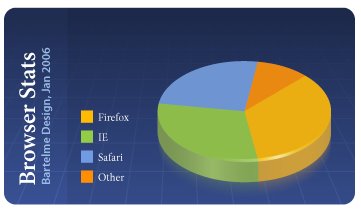
Tired of same ol' MS Office graphs and looking to create a smooth looking graph to add some pizzazz for your next presentation?

Here's a step-by-step guide to create the above graph in Adobe Illustrator by Wolfgang Bartelme! So join me in saying "Thank you Wolfgang!"

[ Links : Creating Graphs 1, Creating Graphs 2 ]

Time for Laughs

Found this comic over at SavageChickens by Doug Savage(brilliant guy). This one is just so brutually true

More on the official site, go check it out!

[via : SavageChicken ]

Saturday, April 08, 2006

Where is Web 2.0 heading?


Recently, there have been so many new websites being set up, claiming to be the latest in what the web has to offer. Mostly, these sites dub themselves to be "web 2.0", a seemingly ubiquitous tag that no one has offered exact specifications on yet. As far as it has gotten to, even O'Reilly and Associates not placed a solid definition on it but rather endeavored to describe what it "feels" to be like and made several comparisons between what they perceive as Web 1.0 companies (e.g : DoubleClick, Ofoto, etc...) and the new Web 2.0 players (e.g: AdSense, Flickr, etc... )

Now, there are hundreds or even thousands of new players who are looking to becoming the next biggest thing to hit the web. Popular areas that have been explored are photo-hosting, video-hosting and creation of web-based sites which mimic desktop productivity software (think Writely and Thumbstacks).

In some sense, the main underlying feel to what the next generation of websites should be (from the general standpoint) along the lines of being fast, user-friendly, smooth, provide a rich user experience and having a large user base. All these translate into having to move fast to be the first player in a certain field and capturing the lion's share by offering services and features that make a difference to web users. In majority of the cases, these services are free to gobble up the market share first.

However, this draws question to the substainability of these business models. Most are heavily reliant on advertising revenue coupled with a large user base. Failing to high a critical mass of users will badly hinder this model. In the developmental order, most of the web has shifted from a "charge-the-users" model to a "charge-the-advertisers" model.

I'm guessing that there will be the emergence of a new form of revenue model for the web soon.

Wednesday, April 05, 2006

Unique Selling Point

This is an article inspired after reading BL's "What makes you different" in sgentrepreneurs

Let's face it, there are tons of companies offering products (when I mention product, read as "products and service" ) in the market out there. In the world of entrepreneurs and investors, it's pretty important for anyone looking to startup to fully understand where they stand on the competitive radar in their industry.

Below is a kind of list on some of the pointers I gleaned over interacting with successful entrepreneurs, investors and from doing good ol' reading:

  1. What is my Unique Selling Point (USP) ?
    This is what sets you aside from the rest. In existing industries, one useful technique from the book Blue Ocean Strategy is to examine all the factors that make up your product, cut back on those which are not important and find new factors which can push you to another playing field.
  2. Are there competitors with the same USP?
    If so, go check up the word "unique" in the dictionary and try from No. 1 again.
  3. I can't seem to find competitors!
    If you hit this, be very very afraid. Because it means that either you haven't dug deep enough in your research or you are trying to meet a non-existent demand. Try harder.
  4. VC - "But I have seen this exact idea crash before!"
    In this scenario, you would hope to have already done your homework on that failure as case study or be able to explain how your USP is different and will substain and scale your idea.
  5. How do I continue to stay ahead of the pack with my USP?
    This is a pretty good question and it seems so far that the only answer to this one is to continue to innovate and evolve. Case in point, just think of how far Google would have gone if they only stuck to perfecting their search engine?
  6. Most importantly - Does your USP make a difference to your consumers?
    Back to the product-centric VS customer-centric argument. The best product in the world, packed with a gazillion features, that does not have a demand makes for a pretty lousy business idea.

Definitely not a complete listing so do drop me a comment if you think anything's missing!


(PS: Guy Kawasaki has a good post on Cialdini's Influence on his blog)